Blogs
How Welding Positioners Make Complex Welding Jobs Easier
Welding positioners eradicated a key job—a job that used to slow down welding operations and cause fatigue and injury for welders as they had to move around the workpiece, work overhead, or sometimes wait for cranes to reposition it.
Welding positioners made welding operations faster and more efficient and let the welders stay at one place and have the workpiece positioned where they can easily reach.
What Is a Welding Positioner?
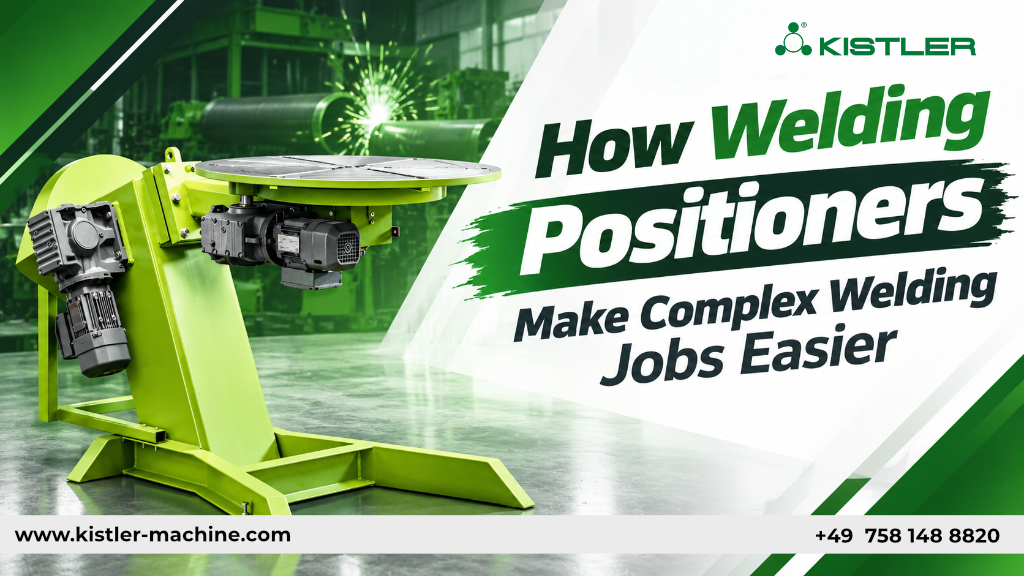
A welding positioner machine holds heavy workpieces and moves them to the positions needed for welding by rotating, tilting, and raising. This lets the welder move less and focus mainly on the welding.
The workpiece is attached to the positioner, and it controls the overall movement.
Some feature 360-degree rotation, while others can change angles or height of the workpiece.
Making Difficult Welding Jobs Easier
Large weldments always come with limited access. This requires the welder to climb, kneel, lie on the floor, or work in an inward position to reach the joint. When the workpiece is movable, the joints are brought to a better position in which the welder can work comfortably.
This avoids having to manually reposition heavy parts and relying on cranes, forklifts, chains, or straps.
Better Access, Better Welds
The flow of the welding process is heavily dictated by the position of the workpiece. Welding in awkward positions makes consistent speed, travel speed, and weld control impossible.
The welding positioner brings the joint into easily accessible positions, allowing the welder to maintain better control. This allows better penetration and weld quality and reduces rework and manual positioning.
Less Time Spent Repositioning
Moving large workpieces manually involves several people and additional handling equipment. This takes time. With the welding positioner, this work becomes easier and more effective. There is no additional time waiting for a crane or setting up equipment to move the part, and this saved time can be used for welding.
A Safer and More Comfortable Work Environment
Welding positioners are also supposed to make the work more comfortable and safe. They rotate the workpiece and reduce the need for welders to work using ladders, scaffolding, or the floor. They also help avoid using chains, straps, forklifts, and cranes for positioning.
Where Are Welding Positioners Used?
Welding positioners are key equipment in industries that primarily deal with large, heavy, or repetitive work. These include construction equipment, agriculture and forestry, mining, aerospace, trailers, trains, subways, boats, power generation, buses, lift trucks, and robotics. They can also be used for applications such as pipe and tube welding, pressure vessel fabrication, shipbuilding, heavy equipment manufacturing, and structural steel work.
Choosing the Right Positioner
In fabrication operations, it offers better control. It holds the workpiece securely without having to repeatedly stop the process. Also, the choice of the type of positioner changes according to the size, weight, and shape of the workpiece, as well as the type of welding and how often the job is repeated.
The welding positioner simplifies the welder’s work by moving the part into better positions that allow more accessibility. This improves workflow and overall workplace worker safety, reduces unnecessary handling, enables consistent welding quality, and makes demanding welding jobs easier to manage.
Turn challenging welding tasks into more controlled processes. Discover
Kistler’s solutions for welding applications.